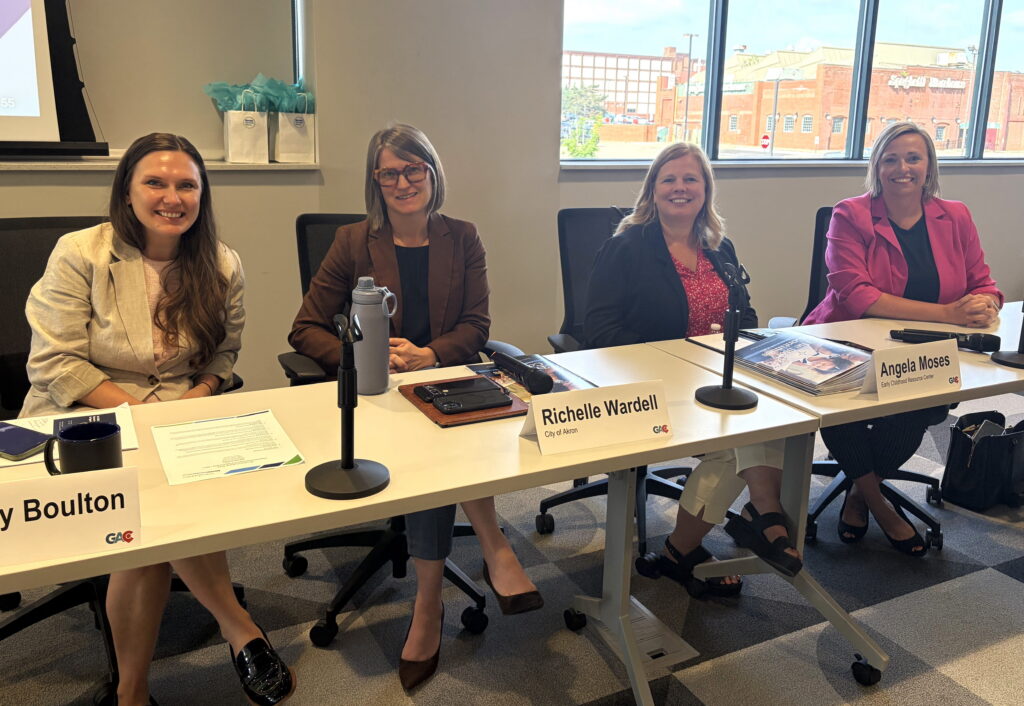
On June 11, employers, policymakers, and community leaders convened at the Greater Akron Chamber for the Workforce Deep Dive on child care.
The goal was simple but urgent: to better understand how child care is shaping our workforce and what it will take to fix a system under strain.
What emerged was clear: child care is not just a family issue. It is a workforce issue, a business issue, and a defining economic issue for our region and state.
Key Takeaways:
1) Child Care is a Critical Social Determinants of Work
Child care directly influences whether parents and caregivers can enter, stay, and advance in the workforce. Without reliable care, even motivated, qualified individuals cannot consistently show up, advance, or stay employed. If we want to improve talent pipelines and economic mobility, we must address these barriers system-wide – not program-by-program
2) Child Care Providers Are Facing a Perfect Storm
At the same time, providers are operating in a fragile system. The challenges in the child care sector mirror those facing many employers but are often amplified.
Providers are navigating:
- Chronic teacher shortages and high turnover (often less than 90 days)
- Teacher burnout and mental health strain, especially as the numbers of children with trauma-related needs increases
- Transportation and housing instability affecting staff
Layered on top of this is a less visible but critical issue: business instability. Many providers are:
- Managing unpredictable staffing and scheduling
- Operating with payment structures tied to attendance rather than enrollment and then absorbing revenue losses when children are absent
- Running complex operations, sometimes without formal business training
This creates a cycle: staffing challenges drive business instability, which in turn affects quality and workforce retention.
3) Child Care Is Economic Infrastructure
Perhaps the most powerful reframing of the day: child care is economic infrastructure.
When the child care system breaks down:
- Workforce participation drops
- Absenteeism increases
- Turnover rises
- Recruitment becomes harder
- Economic growth slows
Child care is “the workforce behind the workforce.”
And the scale of the issue is staggering:
- 1 million Ohio workers have altered their schedules due to child care challenges
- 1 in 4 parents have left the workforce because of these barriers
- Costs exceed $14,000 annually for infant care and $11,000 for older children
- These challenges cost Ohio an estimated $5.48 billion each year in lost productivity and growth
Child care is not optional infrastructure—it is foundational to a functioning economy.
4) Progress Is Happening: UELS and the Child Care Business Accelerator
Akron is not standing still. The City of Akron’s Unified Early Learning System (UELS) focuses on business and leadership development, staffing support, quality improvement, and family navigation and wraparound services. Early results are encouraging:
- Attrition among participating providers has dropped by nearly 60%
- The system is improving enrollment, quality, and workforce stability
- Participating providers have seen ~59% reduction in workforce attrition
- Efforts are improving quality, enrollment, and family connections
Now UELS is working with Elevate Greater Akron to launch a new Child Care Business Accelerator, an effort to strengthen provider operations and financial sustainability, and prepare them for long-term growth. Stabilizing providers is essential to stabilizing the workforce. These efforts position Akron among the most forward-thinking communities in the country.
5) Why Business Leadership Matters—Now
Policy momentum is building, with a significant level of state legislative interest in child care. For example, Ohio recently launched a pilot employer-employee-parent cost sharing program to childcare. But policymakers are clear: they need to hear from employers.
The Business Coalition for Child Care Solutions offers a direct way to engage, shape policy, and advance solutions that work for businesses and employees alike. Business voices are among the most powerful drivers of policy change—and they are needed now.
6) What’s Next
This conversation doesn’t stop here, it continues at Part 2 of the Workforce Deep Dive on September 3 where the focus will turn to employer-driven solutions and innovative approaches across the country.
Child care is one of the few investments that strengthens today’s workforce while building tomorrows. If we want a stronger talent pipeline, lower turnover, and sustained economic growth, this is the issue to engage.
- Join the conversation. Save the Date for Part 2 of the Workforce Deep Dive – September 3, 2026
- Engage your organization. Assess how child care impacts your workforce through recruitment, retention, and absenteeism.
- Use your voice. Consider joining the Business Coalition to help shape state policy.
Akron has an opportunity—not just to respond to this challenge, but to lead. Progress will depend on business leadership stepping forward.